Writing
At Cranbrook Church of England Primary School, we follow a Mastery approach to English through the programme ‘Pathways to Write.’ Units of work are delivered using high quality texts and children in all year groups are given varied opportunities for writing. Skills are built up through repetition within the units, and children apply these skills in the writing activities provided. Many opportunities for widening children’s vocabulary are given through the Pathways to Write approach and this builds on the extensive work we do in school to provide our children with a rich and varied vocabulary.
Handwriting is first taught using print, then pre-cursive, then finally cursive handwriting is expected by all pupils by the time they leave in Year 6. See our handwriting page for further information.
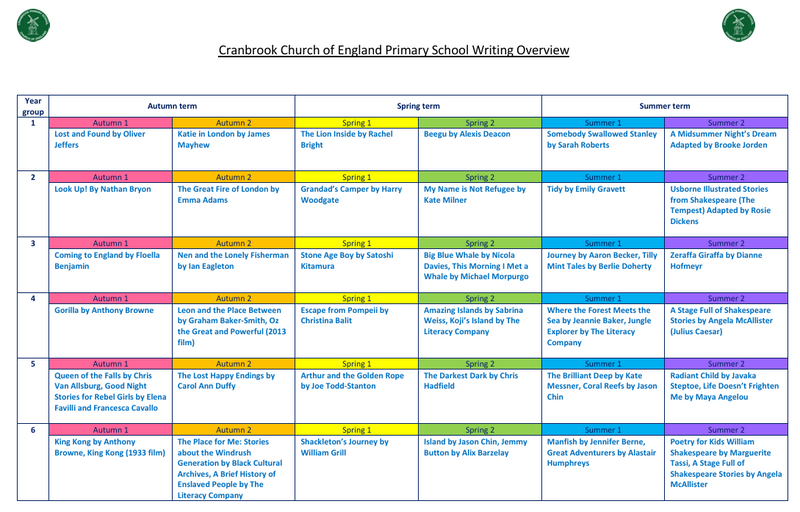
Below you will find our text progression document from Year 1 through to Year 6.
Spellings are practised daily in school and sent home each week to practise at home in preparation for spelling tests on Friday. The National Curriculum spelling lists are below. Please visit class pages to download the spelling by phoneme spelling lists for Years 3-6.
Writing in EYFS
Drawing Club supports early writing in the EYFS by providing a playful, story‑rich environment that aligns with national expectations for emergent writing. The EYFS writing programme highlights that children begin writing through mark‑making, drawing, and using symbols to represent their ideas before they develop secure spelling and handwriting skills. Drawing Club builds directly on this developmental pathway by using imaginative stories, high‑quality picture books, and shared class discussion to spark children’s creativity.
In a typical Drawing Club session, a short whole‑class “time together” introduces children to a narrative world through books, tales, or animations, giving them a shared context and rich vocabulary. Children then explore this story world through drawing and early writing. This helps them give meaning to their marks and develop early composition skills, as emergent writing involves children expressing ideas through drawings and symbolic markings before writing conventionally.
A core principle of Drawing Club is that young children need joy, purpose, and a sense of magic when they write. By framing writing as an imaginative adventure, the approach reduces reluctance and increases engagement. Vocabulary sharing, storytelling, and playful mark‑making help children practise sequencing ideas, articulating thoughts, and experimenting with written symbols—key elements identified in the EYFS writing programme.
For a school such as Cranbrook Primary, integrating Drawing Club into EYFS provision supports the national curriculum goals by nurturing children’s confidence, imagination, and early composition skills. It provides meaningful, enjoyable contexts for writing that prepare children for more formal transcription as they progress through the early years.
Click HERE to read the curriculum overview for EYFS.
National Curriculum Spelling Lists